

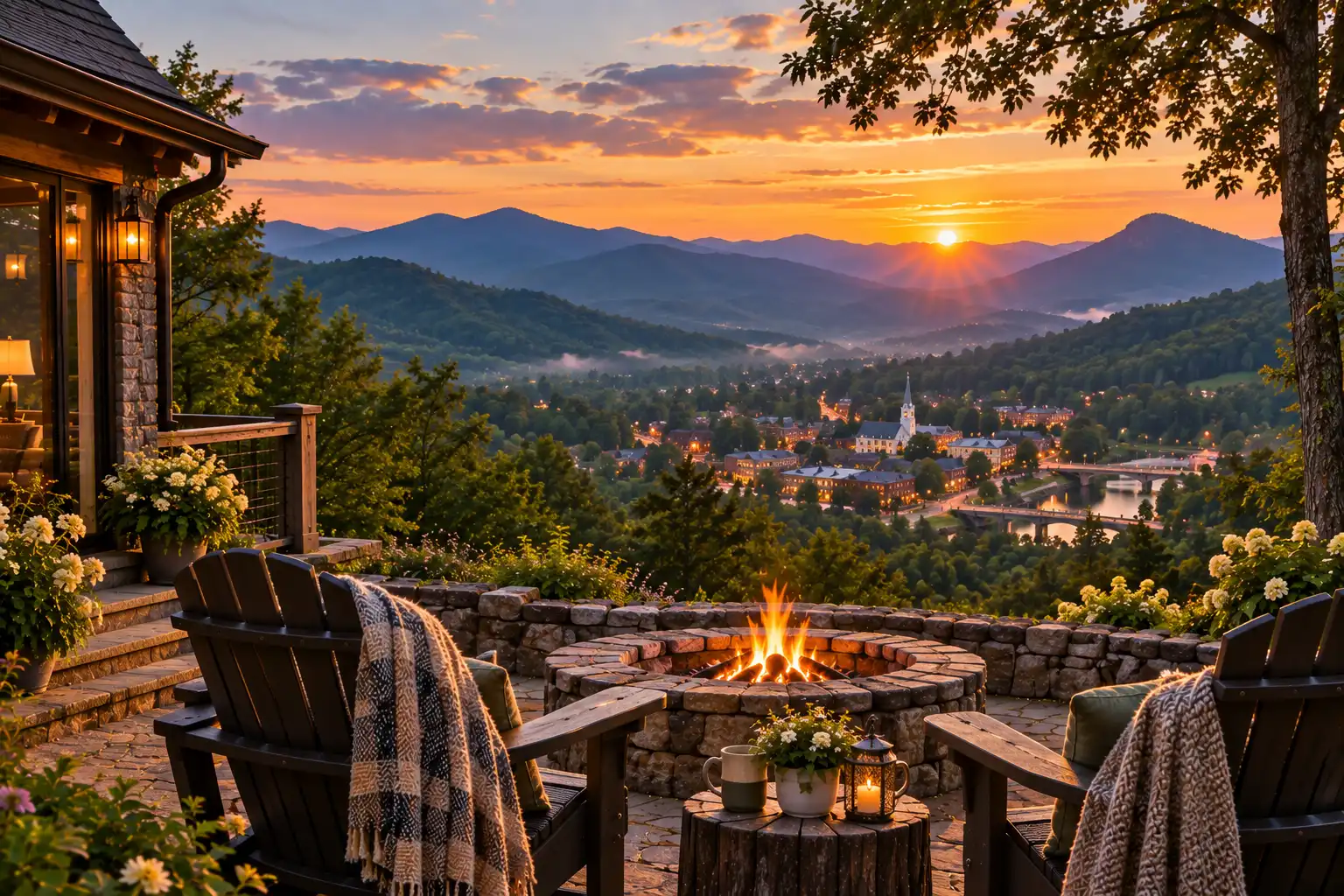
If you’re thinking about moving to Western North Carolina, one of the first things to understand is that there isn’t one single version of “mountain living.”
You can live in a walkable Asheville neighborhood where dinner, live music, coffee and galleries are minutes away. You can trade some of that city energy for a quieter Main Street in Hendersonville or Waynesville. You can put mountain biking and waterfalls at the center of your weekends in Brevard, or look toward Highlands and Cashiers for a more private, club-oriented mountain lifestyle.
That variety is exactly what makes Western North Carolina so appealing—and also why choosing the right community matters as much as choosing the right house.
The communities below aren’t ranked from best to worst. Instead, think of this as a starting point for figuring out which version of WNC life feels most like yours.
1. Asheville: For People Who Want Mountain Living Without Giving Up City Life
Asheville is the natural starting point for many people researching Western North Carolina. It offers something most smaller mountain towns can’t: a genuine city lifestyle surrounded by the Blue Ridge Mountains.
The appeal is the combination. You can spend Saturday morning hiking, come home for the afternoon, and still have dozens of restaurants, breweries, galleries and live-music options that evening. Asheville’s official tourism site describes a city with more than 30 downtown galleries, a strong culinary and music scene and immediate access to the mountains.
What living in Asheville feels like
Asheville tends to work especially well for buyers who prioritize restaurants, culture, walkability, professional amenities and easier access to everyday services, but still want the outdoors to be a major part of life.
The important thing is that “Asheville” can mean very different things depending on the neighborhood. Downtown and nearby historic neighborhoods offer an urban or walkable experience, while other parts of the city can provide wooded lots, mountain views and significantly more privacy.
Real estate is equally varied. Depending on where you look, you’ll find historic bungalows and Arts and Crafts homes, downtown condos, newer infill construction, established suburban neighborhoods, luxury properties, golf communities and larger mountain homes tucked into the surrounding ridges.
For someone relocating here, we’d spend just as much time talking about which part of Asheville fits your daily routine as we would talking about the house itself.
Local places worth knowing
Start with Downtown Asheville and the city’s official visitor guide to understand the broader area. The River Arts District is one of the best places to get a feel for Asheville’s creative side, with working studios, galleries, cafés and breweries clustered along the French Broad River.
Biltmore Estate is the city’s best-known landmark, but it is also worth exploring nearby Historic Biltmore Village for its shops and restaurants.
Golfers should look at the broader Asheville golf scene, including the historic course at the Omni Grove Park Inn. For dining, Asheville’s local favorites span an enormous range; Explore Asheville’s local favorites guide is a useful starting point and includes Cúrate, Sunny Point Café, Nine Mile and others.
Asheville may belong on your shortlist if: you want the most complete combination of mountain access, dining, culture, employment, services and neighborhood variety in WNC.
2. Hendersonville: A Walkable Main Street With More Room Around the Edges
About 25 miles south of Asheville, Hendersonville offers a different rhythm.
Its historic downtown is genuinely useful—not simply a few souvenir shops arranged for weekend visitors. Main Street has restaurants, galleries, shops, events and gathering places, and the broad sidewalks make downtown particularly pleasant to explore on foot.
Outside downtown, Henderson County quickly transitions into rolling countryside, orchards, established residential communities and mountain terrain.
What living in Hendersonville feels like
Hendersonville is worth a serious look for buyers who like the idea of small-city convenience, a traditional downtown, outdoor recreation and access to Asheville without needing to live in Asheville itself.
It can also make sense if you’re comparing a downtown home or condo with something that offers more land. Drive 10 or 15 minutes from Main Street and the landscape changes considerably.
Housing includes historic homes near downtown, condos and townhomes, established neighborhoods, newer communities, golf-oriented developments, mountain-view properties and homes with larger lots or acreage in the surrounding county.
The opening of portions of the Ecusta Trail is another interesting piece of the area’s long-term lifestyle picture, connecting recreation with downtown and eventually creating a nearly 20-mile corridor toward Brevard.
Local places worth knowing
Spend an afternoon walking Historic Downtown Hendersonville, then use the official Hendersonville dining, shopping and activities guide to explore beyond Main Street.
One of the best quick mountain outings is Jump Off Rock in neighboring Laurel Park, where you’ll find a panoramic overlook and several short trails.
Henderson County is also apple country. The area’s orchards, farms and markets are a meaningful part of local life, particularly from late summer through fall.
And in nearby Mills River, Sierra Nevada Brewing Co. has become a major regional destination with a brewery, taproom and restaurant.
Hendersonville may belong on your shortlist if: you want a lively but manageable downtown, access to Asheville and the airport, and the option to choose between in-town living and a more rural or mountain setting.
3. Brevard: Where Outdoor Recreation Is Part of Everyday Life
Brevard isn’t simply a mountain town near good hiking. Outdoor recreation is deeply embedded in the community’s identity.
Pisgah National Forest sits practically at the town’s doorstep, while DuPont State Recreational Forest is nearby. The area is known for waterfalls, mountain biking, hiking, fly fishing and an unusually strong outdoor culture. The local tourism organization points to hundreds of miles of trails and dozens of waterfalls throughout the surrounding area.
Yet Brevard also has a real downtown and a significant arts and music presence, which gives it more depth than a purely recreation-driven destination.
What living in Brevard feels like
Brevard tends to resonate with people who want mountain biking, hiking, paddling, fishing and public lands to be part of normal life rather than occasional weekend trips.
Downtown itself is compact, active and filled with independent restaurants, shops and galleries.
Housing ranges from older homes close to downtown to newer communities, cabins, wooded mountain homes, larger tracts outside town and higher-end properties with views or substantial acreage. Buyers seeking privacy often expand their search into Pisgah Forest, Cedar Mountain and other parts of Transylvania County.
The tradeoff is worth understanding: Brevard feels more removed from Asheville’s city amenities than communities closer to I-26. For some buyers, that’s exactly the point.
Local places worth knowing
Explore Downtown Brevard first, then head toward DuPont State Recreational Forest for waterfalls, hiking, mountain biking and horseback riding.
The Pisgah Forest area is where you’ll also find The Hub, part bike shop, part outdoor gathering place and a good example of how integrated cycling culture is here.
For a post-adventure beer, Oskar Blues Brewery’s Brevard taproom is a local institution.
Brevard’s other major calling card is Brevard Music Center. Its wooded 180-acre campus hosts a nationally known summer music institute and festival, with performances ranging from orchestra and opera to jazz and bluegrass.
Brevard may belong on your shortlist if: access to trails, waterfalls and outdoor recreation is one of the main reasons you’re moving to Western North Carolina.
4. Black Mountain: Small-Town Walkability Close to Asheville
Black Mountain is one of those places that can change a buyer’s search after a single afternoon downtown.
Located roughly 15 minutes east of Asheville, it has an unusually strong small-town center for its size: local restaurants, cafés, galleries, shops, breweries and community events are concentrated into an area that’s easy to explore on foot.
The overall feeling is relaxed, creative and distinctly mountain-town.
What living in Black Mountain feels like
Black Mountain is particularly appealing to buyers who want a walkable small-town environment and a strong sense of place while remaining reasonably close to Asheville.
The surrounding mountains are always present, and it doesn’t take long to move from downtown streets into wooded residential areas and higher-elevation communities.
Real estate ranges from cottages and older homes near town to newer construction, mountain communities, cabins, view properties and larger luxury homes. A buyer who wants to walk to coffee has a very different search here than someone looking for a private mountain retreat—yet both can use a Black Mountain address.
Local places worth knowing
Use the Town’s Discover Black Mountain guide to explore the shops, events and downtown businesses.
For food and drink, Black Mountain’s local dining directory includes places such as Blue Ridge Biscuit Company, Trailhead, Veranda Café and a growing collection of restaurants and bars.
Beer is part of the local landscape, too. The area’s brewery guide includes Black Mountain Brewing, Lookout Brewing and Pisgah Brewing.
The appeal here isn’t a checklist of major attractions. It’s the ability to walk into town, recognize familiar faces, grab coffee or dinner, attend a local event and still be within easy reach of Asheville.
Black Mountain may belong on your shortlist if: you want small-town character and walkability without giving up relatively easy access to Asheville.
5. Weaverville: A Quieter Alternative Just North of Asheville
Weaverville often enters the conversation when someone likes Asheville but realizes they don’t necessarily need to be in the middle of it.
Just north of the city, Weaverville has a compact Main Street, local restaurants, galleries, breweries, parks and a slower pace. The town itself describes the experience as where “the mountains meet Main Street,” which is a pretty accurate summary.
What living in Weaverville feels like
Weaverville works well for people looking for proximity to Asheville combined with a smaller-town setting, mountain scenery and the possibility of more space.
In and around town you’ll find established neighborhoods and homes near Main Street, while the surrounding Reems Creek and North Buncombe areas offer everything from newer homes to larger lots, wooded settings, mountain views and acreage.
It’s also worth considering for buyers whose daily lives still pull them into Asheville but who would rather come home to somewhere quieter.
Local places worth knowing
Downtown Weaverville and its local shopping district are easy to explore on foot, with galleries, outfitters, specialty shops and locally owned businesses.
Well-Bred Bakery & Café on Main Street is a longtime local gathering spot, while the broader Weaverville food and drink guide includes local breweries, pizza, wine shops and restaurants.
Golfers should know Reems Creek Golf Club, a mountain course set just outside town with public tee times as well as membership options.
For something simpler, Lake Louise and the town’s parks make it easy to build walking and outdoor time into an ordinary weekday rather than having to drive to a trailhead every time.
Weaverville may belong on your shortlist if: you want Asheville nearby but prefer a smaller community, quieter surroundings and the possibility of more land.
6. Waynesville: A True Mountain Town Near the Smokies
Head west from Asheville and the mountains start to feel bigger. Waynesville sits in Haywood County between the Blue Ridge and Great Smoky Mountains and has one of Western North Carolina’s strongest traditional downtowns.
Its Main Street combines independent shops, galleries, restaurants, breweries and community events in a downtown that functions as a genuine center of town.
What living in Waynesville feels like
Waynesville appeals to people who want a self-contained mountain town with a real downtown, strong outdoor access and less dependence on Asheville.
You’re close to the Blue Ridge Parkway and Great Smoky Mountains National Park, and the surrounding valleys and ridges create some beautiful residential settings.
Housing ranges from older homes close to downtown to cabins, newer homes, established communities, larger rural properties and mountain-view estates. Nearby communities such as Maggie Valley, Clyde and Lake Junaluska broaden the options considerably.
For buyers prioritizing acreage or views, this part of WNC is often worth exploring in person because two properties that appear close together on a map can have dramatically different elevations, roads and terrain.
Local places worth knowing
Begin with Downtown Waynesville and spend time walking Main Street rather than simply driving through.
Boojum Brewing Company sits right on Main Street with its brewery restaurant and downstairs Gem Bar. Nearby, Frog Level Brewing has a creekside beer garden, food and live music.
For barbecue, Haywood Smokehouse’s Waynesville location is well worth knowing.
A few minutes away, the Lake Junaluska Walking Trail offers a mostly flat paved loop with mountain and lake views—a good reminder that outdoor life here doesn’t always require a strenuous hike.
Waynesville may belong on your shortlist if: you want a classic Western North Carolina mountain-town experience with a strong Main Street and easy access to the Smokies.
7. Highlands: Refined Mountain Living at 4,118 Feet
Highlands is a very different proposition from Asheville, Hendersonville or Waynesville.
At 4,118 feet, the town combines dramatic natural surroundings with a polished downtown known for restaurants, boutiques, galleries and cultural institutions.
For buyers interested in a second home, luxury mountain property, golf community or seasonal retreat, Highlands is one of the most important markets in Western North Carolina to understand.
What living in Highlands feels like
Life here revolves around the plateau: cool mountain air, waterfalls, forest trails, golf, long lunches, downtown shopping and evenings out.
Highlands is particularly appealing when privacy, scenery, club amenities and a sophisticated small-town environment rank highly on the wish list.
Real estate reflects that positioning. Expect mountain cottages and older in-town homes alongside renovated luxury properties, substantial view homes, private club communities and architecturally distinctive estates.
Proximity to Main Street can carry real lifestyle value for someone who wants to walk to dinner and shops, while buyers looking farther outside town may prioritize views, larger homesites and privacy.
Local places worth knowing
Walk Main Street Highlands to understand why downtown is such a major part of the appeal. The town has an unusually strong collection of independent boutiques, galleries and specialty shops for a mountain community of its size.
The local Highlands restaurant guide is useful because dining is a meaningful part of life here, from casual cafés to destination restaurants and wine programs.
For art, visit The Bascom and Highlands’ visual-arts scene. The Bascom occupies a six-acre campus near downtown with exhibitions, ceramics, classes, sculpture and trails.
Then there are the waterfalls. Dry Falls and the Highlands waterfall guide should be on any first exploration of the area.
Golf is equally important. Highlands Country Club dates to 1928 and features a Donald Ross-designed course, while Old Edwards Club offers a Tom Jackson-designed course and club amenities.
Highlands may belong on your shortlist if: you want an elevated second-home or primary-home environment centered around dining, shopping, nature, golf and private-club living.
8. Lake Lure: Lakefront Living With a Mountain Backdrop
Lake Lure offers something a little different from the other communities on this list: a true lake-and-mountain lifestyle.
Set in the Hickory Nut Gorge southeast of Asheville, Lake Lure is surrounded by dramatic mountain scenery, with the lake itself at the center of the community’s identity. Nearby Chimney Rock adds another layer of outdoor access, while Asheville and Hendersonville remain within reach for larger-city amenities.
For buyers who picture Western North Carolina living as mornings overlooking the water, afternoons hiking or boating, and evenings somewhere quiet and scenic, Lake Lure deserves a closer look.
What living in Lake Lure feels like
Lake Lure tends to appeal to people who value water access, mountain scenery, outdoor recreation, privacy and a quieter pace of life.
It’s considerably different from living in Asheville or even Hendersonville. There isn’t a large, walkable downtown filled with restaurants and shops. Instead, the lifestyle is more spread out and property-oriented. Your home, neighborhood, lake access and immediate surroundings can play a much bigger role in everyday life.
That makes Lake Lure especially interesting for buyers considering a second home, lake property, mountain retreat, golf community or primary residence away from a busier urban environment.
Real estate can include lakefront homes and cottages, mountain-view properties, cabins, wooded homesites, newer construction and homes within established communities. Buyers looking for additional amenities may also explore communities such as Rumbling Bald, where golf and recreation are built into the lifestyle.
Lake access is an important distinction when comparing properties. A home with direct lake frontage, deeded or community access, a nearby marina, or simply a lake view can offer very different experiences—and potentially very different ownership considerations.
Local places worth knowing
The natural starting point is Lake Lure itself. Before buying, it’s worth getting familiar with the Town of Lake Lure because lake management, recreation, infrastructure and local regulations can directly affect property owners.
Just beyond town, Chimney Rock State Park is one of Western North Carolina’s signature outdoor destinations. The park is known for its enormous rock outcropping overlooking Hickory Nut Gorge, along with hiking trails and views stretching across Lake Lure and the surrounding mountains.
The neighboring Village of Chimney Rock adds local restaurants, shops and a classic small mountain-village atmosphere along the Rocky Broad River.
For golf-oriented buyers, Rumbling Bald on Lake Lure is an important community to know. The resort and residential community includes two golf courses—Bald Mountain and Apple Valley—along with lake access, racquet sports, wellness and other recreational amenities.
The broader Blue Ridge Foothills tourism guide is also useful for exploring Lake Lure, Chimney Rock and the surrounding communities.
What buyers should understand about Lake Lure
Lake Lure is a community where the details of the individual property matter enormously.
A lakefront home, a house high above the lake with long-range views and a home inside a golf community can all have a Lake Lure address while delivering completely different lifestyles.
Buyers should also do careful due diligence around lake access, topography, roads and driveways, septic systems, drainage, insurance and property-specific restrictions. Because Lake Lure and the surrounding Hickory Nut Gorge were significantly affected by Hurricane Helene in 2024, buyers should also review current infrastructure conditions, lake-management information and property-specific storm history rather than relying on pre-Helene assumptions.
Lake Lure may belong on your shortlist if: you want mountain living with a strong lake component and prioritize scenery, outdoor recreation, privacy, golf or second-home potential over having a traditional walkable downtown.
How Do You Choose the Best Place to Live in Western North Carolina?
The best place to live in Western North Carolina isn’t necessarily the town with the longest list of attractions. It’s the place where your normal Tuesday works.
That means asking more practical questions.
Do you want to walk to coffee and dinner, or would you happily drive 15 minutes in exchange for five acres and a view? Do you expect to be in Asheville several times a week? Is golf central to the lifestyle you’re looking for? Do you want immediate trail access? Would you rather live in a neighborhood, a private club community, beside a lake or on an independent mountain property?
And in WNC, the property itself requires another layer of consideration. Elevation, road grade, driveway access, winter exposure, well and septic systems, drainage, internet availability, tree cover, slope and property maintenance can matter just as much as square footage.
That’s why we generally recommend choosing the lifestyle first, narrowing the geography second and shopping for the house third.
A Quick Way to Narrow Your WNC Search
If you want the broadest combination of restaurants, culture and amenities, start with Asheville.
If you want a walkable smaller city with surrounding countryside, look closely at Hendersonville.
If mountain biking, waterfalls and public lands are central to the move, put Brevard high on the list.
If you want small-town walkability near Asheville, spend time in Black Mountain.
If you want a quieter home base with Asheville close by, explore Weaverville.
If you want a traditional mountain town close to the Great Smoky Mountains, consider Waynesville.
If you’re looking for luxury, golf, dining and a walkable high-elevation town, explore Highlands.
And if lake living, mountain scenery, golf and outdoor recreation are high on the wish list, take a serious look at Lake Lure.
Before You Decide, Spend Time Here Like a Local
One of the biggest mistakes we see when people relocate to Western North Carolina is evaluating a community entirely through vacation eyes.
A beautiful weekend is useful, but before buying, try the ordinary version of the place too.
Drive the route to the grocery store. Visit at 8 a.m. on a weekday. See how long it takes to get to the airport, medical appointments or the places you’ll use regularly. If you’re considering a mountain property, drive to it after dark and in less-than-perfect weather. Spend time in the actual neighborhood rather than just downtown.
Most importantly, compare several communities before deciding.
Someone who arrives convinced Asheville is the answer may discover Black Mountain fits better. Someone looking at Hendersonville may realize Brevard puts them closer to the recreation they actually care about. And someone picturing a traditional mountain home may discover that having Lake Lure outside the back door changes the equation entirely.
That’s part of the fun of finding your place in Western North Carolina: the mountains offer more than one way to live here.
Thinking About Moving to Western North Carolina?
At Varga Mountain Collective, our goal isn’t simply to find you a house. It’s to help you understand the communities, terrain and property types well enough to make a confident decision about where you actually want to live.
If you’re still deciding between Asheville, Hendersonville, Brevard, Black Mountain, Weaverville, Waynesville, Highlands, Lake Lure, or somewhere in between, we can help you compare the options and narrow the search around the lifestyle you’re trying to create. Let’s chat about what you’re looking for and find the places that feel like the right fit.
Kelsey Varga
828.335.1530 | kelseyvarga@compass.com
Social Cookies
Social Cookies are used to enable you to share pages and content you find interesting throughout the website through third-party social networking or other websites (including, potentially for advertising purposes related to social networking).